AI amplifies the system it's plugged into
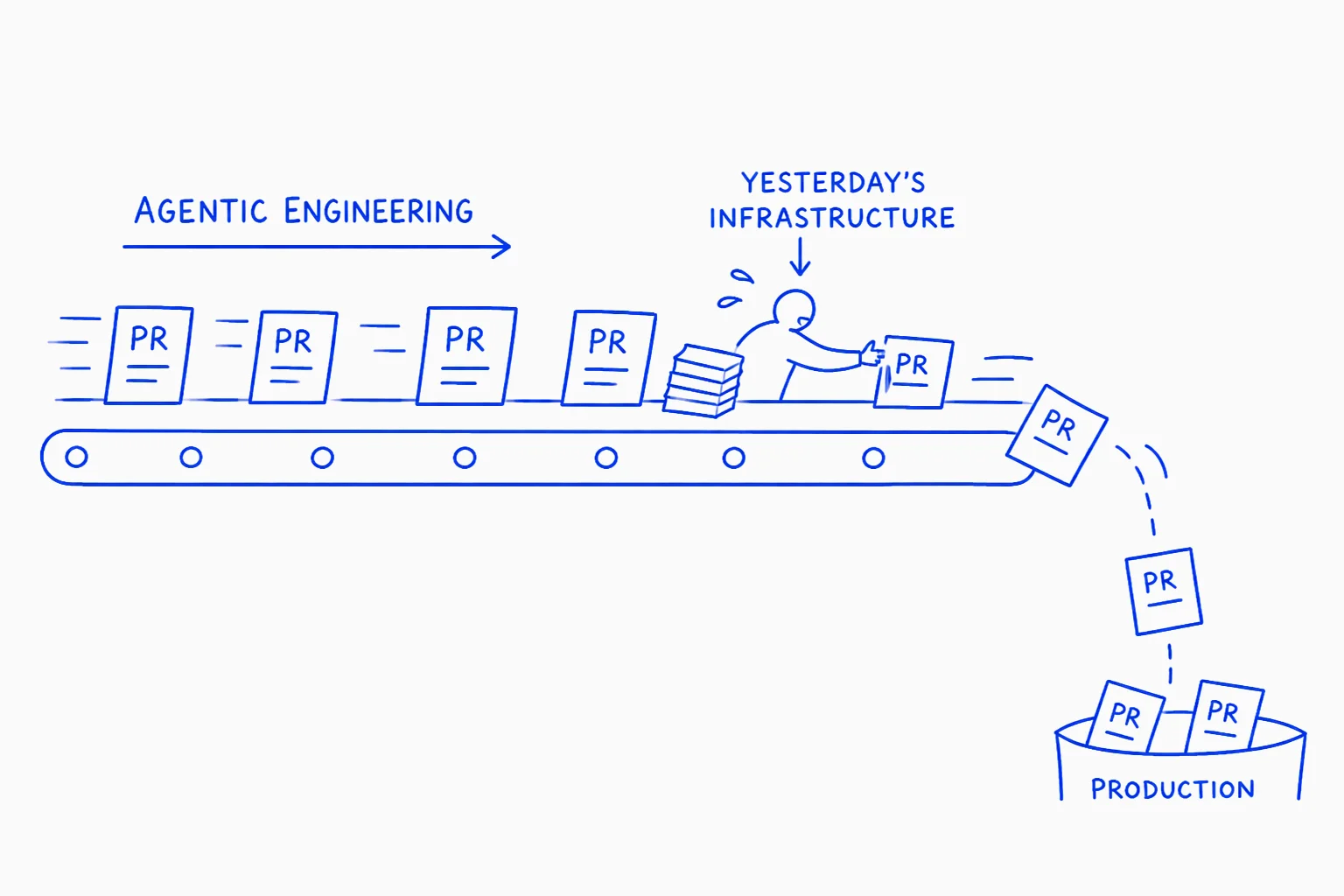
DORA’s 2025 report shows AI is making engineering teams faster and less stable at the same time. Throughput is up. More code is being written and merged. Instability is also up: more failed changes, more rework, more production incidents.
The tempting read is that AI introduces risk. The actual finding is more useful. AI amplifies the system it’s plugged into. A strong engineering org gets stronger. A weak one runs into its weaknesses faster.
The speed/stability tradeoff was always a myth
For a long time, “fast” and “stable” were treated as opposing dials. Move faster, and you’d break things. Slow down, and you’d ship safely. DORA has been pushing back on this for a decade. The highest-performing teams are both fast and stable, and the 2025 numbers back that up.
So when AI cranks speed up and stability down on the same team, that isn’t a property of AI. It’s a sign the system around the AI hasn’t caught up.
Where the cracks open
The report points to a few specific failure modes that show up when teams adopt AI without adapting around it.
The most visible is local optimization. AI makes individual engineers more productive, but reviewers, CI, QA, and release pipelines were sized for a slower upstream. When they don’t scale with the new pace, the upstream gains turn into downstream queues and late-stage rollbacks.
A subtler one is the gap between adoption and trust. Around 90% of teams are using AI; only about 70% actually trust what it produces. People are shipping code they don’t fully believe in, then re-checking it more carefully than they’d have checked their own work. The writing got faster. The path to “I’m confident this is correct” didn’t, and may have gotten longer.
Underneath both is a mismatch in feedback. AI accelerated the writing of code without accelerating the validation of code. That gap is where most of the new instability lives. DORA’s point is direct: when one part of the system speeds up, the control mechanisms have to speed up with it, or the system gets less reliable.
The teams pulling ahead aren’t the ones using AI most
DORA breaks teams into profiles, and the top performers aren’t defined by AI usage at all. They’re defined by what they did to the surrounding system: fast automated feedback, internal platforms that abstract the boring parts, workflows from PR to prod with no dead spots, environments where doing the right thing is easier than the wrong thing.
What AI is actually doing to engineering organizations is forcing a reckoning. The practices that held things together at lower velocities (manual review as the safety net, tribal knowledge for edge cases, humans as the validation layer) were never going to survive a 3x throughput increase. They just didn’t have to be replaced before now.
The bottleneck has moved
For a long time, the constraint on shipping software was writing it. AI dissolved that constraint faster than most teams expected. The new constraint is everything that has to happen between “code exists” and “code is correct in production”: review, understanding, observability, recovery.
This is the shift that matters. Engineering orgs that treat AI as a way to write more code, faster, will keep getting the DORA result. The orgs that come out ahead are using AI as a forcing function to rebuild the validation half of their pipeline at the same speed as the generation half.
This is why we built Macroscope around code review. If generation has gone 10x and review hasn’t, the bottleneck just moved, and the team that closes that gap first is the one that gets to keep its speed without paying for it in instability.
The DORA report doesn’t really say AI is dangerous. It says your old system can’t carry the new throughput. Which is a much more actionable problem.